BFSG: the German Accessibility Act for online shops
The BFSG (Barrierefreiheitsstärkungsgesetz) is Germany's implementation of the European Accessibility Act. Since 28 June 2025 it requires covered consumer services, including online shops that are not micro-enterprises, to be accessible and to publish accessibility information under §14. Supervision lies with the MLBF in Magdeburg; §37 provides for fines of up to €100,000.
By Vadym Liubyvyi, founder of Pandus · Updated October 28, 2026 · 7 min read · How we write and check our guides
This page is general information, not legal advice.
We wrote this page for the people who ask us about the BFSG most: agencies outside Germany with German clients, and shops that sell into Germany from Poland, Czechia or Ukraine. The German-language version, which also covers associations, medical practices and the transition rules in §38, is at BFSG: Barrierefreiheit der Website.
Who the BFSG applies to
The same three questions as the EAA decide it:
- the service is offered to consumers (B2C), meaning natural persons acting mostly outside their trade or profession (§2 no. 16);
- it is a covered service, such as e-commerce, consumer banking, e-books, passenger transport or electronic communications (§1(3));
- the provider is not a micro-enterprise: fewer than 10 employees and a turnover or balance sheet of no more than €2 million (§2 no. 17, §3(3)).
Many small German shops are exempt. A point that confuses German readers: the BFSG uses the EU definition of a micro-enterprise, not the "Kleinunternehmer" rule from tax law. Check your case with the three-question filter.
What the BFSG requires from a shop
- The website, app and ordering process must be perceivable, operable, understandable and robust for people with disabilities. The technical reference is EN 301 549, whose web chapter follows WCAG: currently V3.2.1 (WCAG 2.1 AA), with V4.1.1 (WCAG 2.2 AA) published in September 2026 and expected to be cited in late 2026.
- §14 and Annex 3 (Anlage 3): the provider must publish information on how the service meets the accessibility requirements, in an accessible form, in the general terms and conditions or in another clearly visible way. In practice many shops publish a separate page called "Barrierefreiheitserklärung" and link it in the footer.
What we see on German shop pages
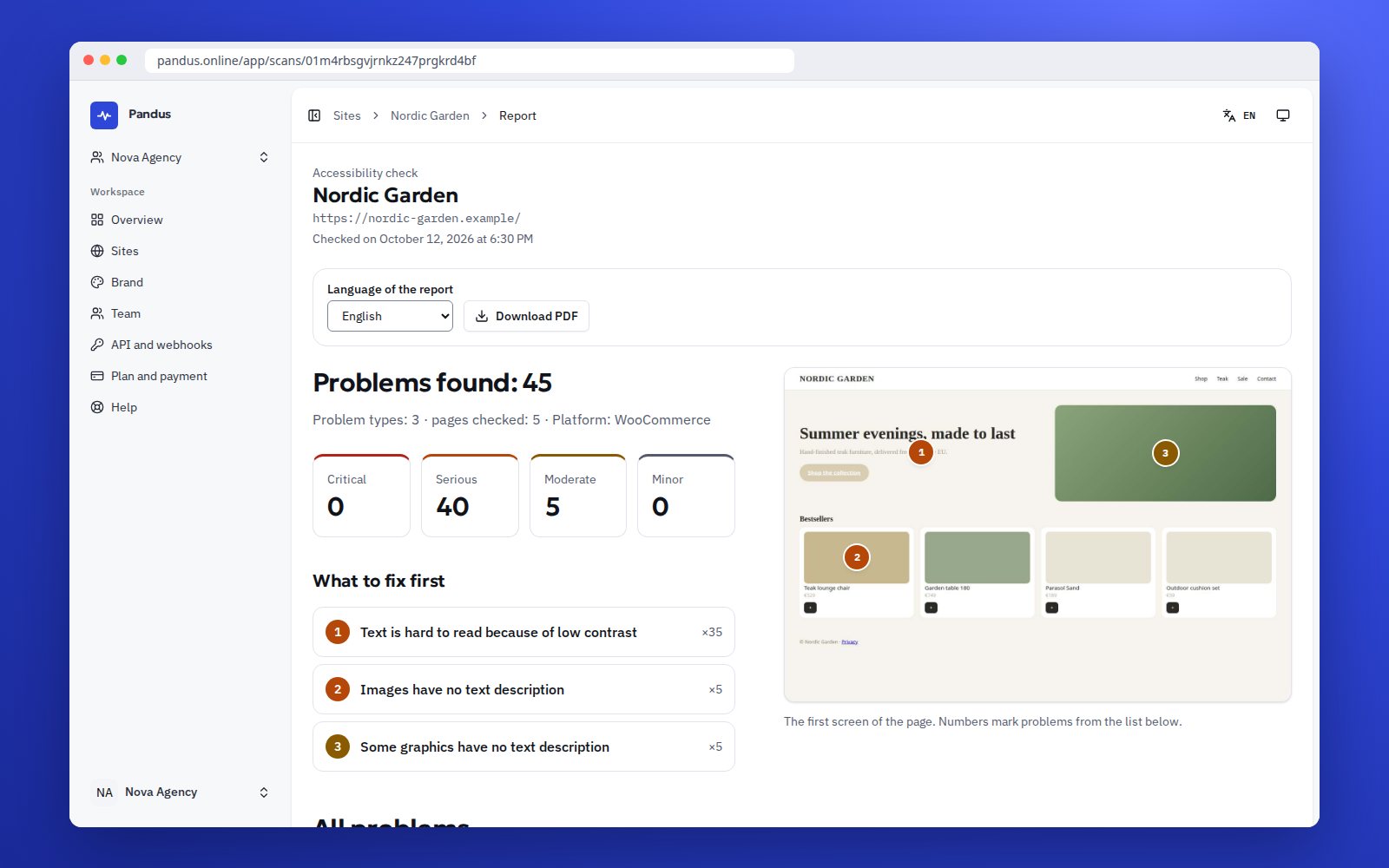
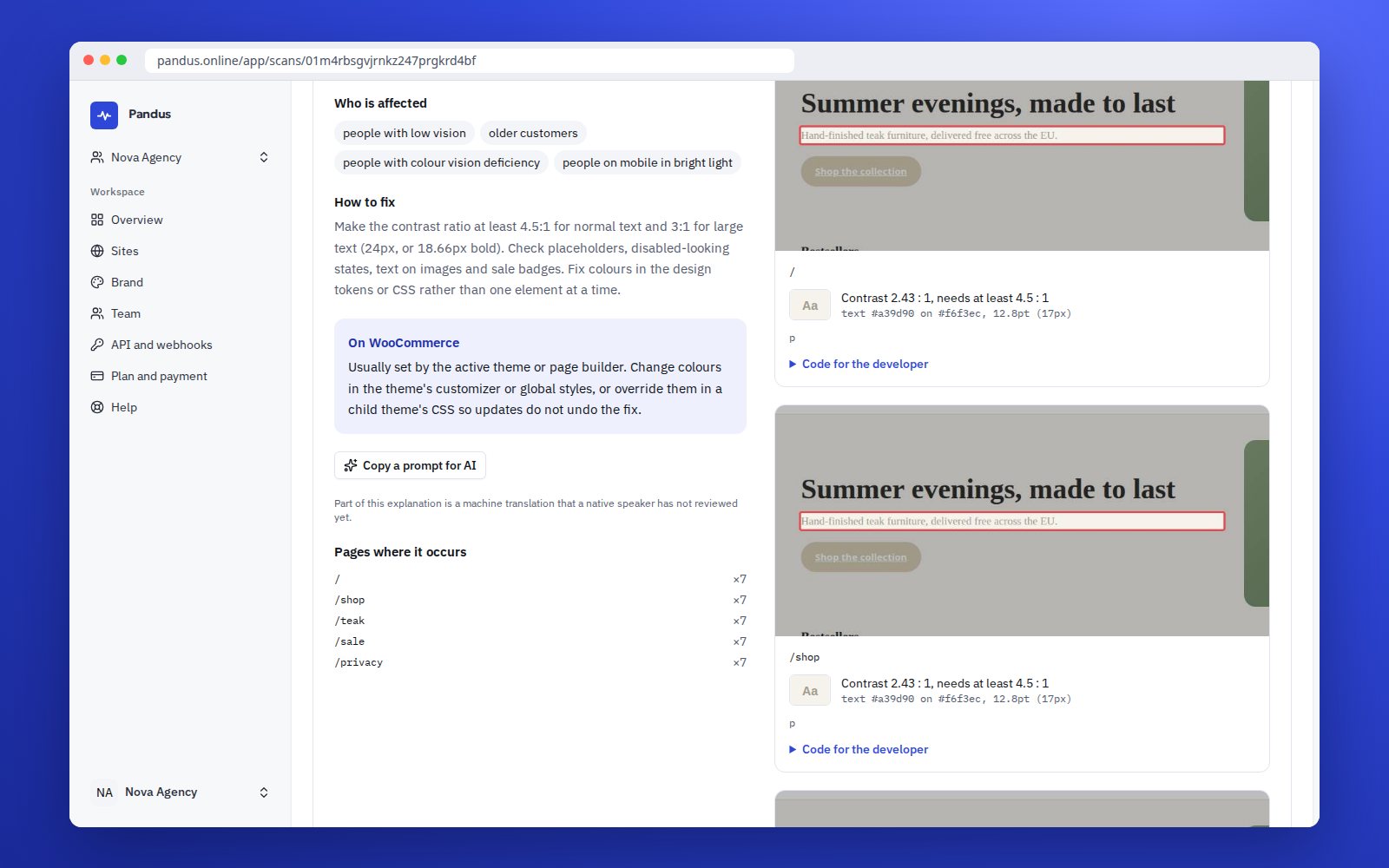
On 13 October 2026 we ran the automated WCAG 2.2 A and AA rules on the home pages of 68 well-known German online shops, as part of a study of 289 shops in five countries. Germany had the best median score of the five, 84 out of 100, and 26% of its home pages had a critical problem, second only to Czechia (22%). That is the good news, and it comes with three details worth knowing if you build or maintain a German shop:
- The most common failure in Germany is not contrast. It is a button or link whose hidden name does not match its visible text (WCAG 2.5.3): 33 of 68 home pages, 48%. For example a search button that shows "Suchen" but carries
aria-label="search". Sighted customers never notice; anyone who drives the page by voice cannot press it. - Icon links without a name came second (27 pages, 40%), low contrast third (26 pages, 38%). Blocked zoom on mobile, a plague elsewhere, was rare in Germany: 5 pages.
- Six home pages passed every automated rule: Breuninger, Deichmann, Hornbach, JYSK, kfzteile24 and Rossmann. Deichmann and JYSK did the same in Poland and Czechia, Hornbach in Czechia and Romania: a good template travels. Rossmann did not: 94 in Poland, 71 in Czechia, three local sites with three results.
One page per shop and never the checkout, so these numbers understate the problem. They do show what anyone who opens the home page with a screen reader finds in the first minute.
The accessibility information (§14, Anlage 3)
Following Annex V of the EAA, the information covers, in plain language:
- a general description of the service in accessible formats;
- descriptions and explanations needed to understand how the service works;
- how the service meets the relevant accessibility requirements.
Many shops also add known limitations, a contact for accessibility feedback and the name of the supervisory authority. That is good practice; check the exact list with your lawyer.
The market surveillance authority can check this information, and a missing or incorrect statement is itself a breach. It is also the easiest one for anyone to find: open the footer. Our accessibility statement guide explains structure and common mistakes, and the generator produces a German draft from a questionnaire for your lawyer to review. A scanner cannot write this document, because it describes your service; our scan results go only into the "known limitations" part.
Supervision: the MLBF
The federal states set up a joint authority, the Marktüberwachungsstelle der Länder für die Barrierefreiheit von Produkten und Dienstleistungen (MLBF), based in Magdeburg. It started work in September 2025. It can check services, handle complaints from consumers and associations, and order corrections.
Fines under §37
- Up to €100,000 for certain breaches, including providing a service that does not meet the requirements of §14(1).
- Up to €10,000 for missing or incorrect accessibility information.
These are maximum amounts. As of October 2026 we are not aware of confirmed BFSG fines against online shops; the current picture is inspections, complaints and legal disputes. We do not use the figure as a sales argument and recommend distrusting anyone who does.
Warning letters (Abmahnungen)
Besides the authority, Germany has a second enforcement route: competitors and qualified associations can send formal warning letters (Abmahnungen) with a cost note when they consider a breach to be unfair competition. Whether and how this applies to BFSG requirements is a legal question for your lawyer; a missing Barrierefreiheitserklärung is the most visible target. This, more than the MLBF, is why German shops and their agencies take the topic seriously, and why the statement should be done carefully, not copied from a template.
Practical steps for a German shop
- Check whether the BFSG applies to you with the three questions.
- Scan the product template and the checkout, not only the home page. Our free check covers one public page in German; the browser extension reaches the checkout with items in the cart. Both are automated checks, not a full audit, and not legal advice.
- Fix by severity: the unnamed "In den Warenkorb" button before the grey footer text. Then contrast, then the hidden-name mismatches that German pages are prone to. The WCAG 2.2 checklist has the order.
- Test the whole purchase by hand with a keyboard and a screen reader; automation does not reach that far.
- Publish the §14 information, keep it true, and check again after every theme or plugin update.
Our reports are available in German, under an agency's own brand if you work for one, with the §14 draft from the questionnaire. For the EU background, read the EAA guide.
Frequently asked questions
What is the BFSG?
The Barrierefreiheitsstärkungsgesetz is the German law that implements the European Accessibility Act. It applies to covered products and consumer services, including e-commerce, since 28 June 2025.
Who supervises the BFSG?
The Marktüberwachungsstelle der Länder für die Barrierefreiheit von Produkten und Dienstleistungen (MLBF) in Magdeburg, which started work in September 2025.
How high are BFSG fines?
Section 37 provides for fines of up to 100,000 euros for certain breaches, including providing a service that does not meet the requirements, and up to 10,000 euros for missing or incorrect accessibility information. We know of no confirmed fines against shops as of October 2026.
Do micro-enterprises have to comply with the BFSG?
No. Micro-enterprises that provide services are exempt from the service requirements, in line with the European Accessibility Act. The BFSG means the EU definition (fewer than 10 employees and turnover or balance sheet of at most €2 million), not the German tax rule for small businesses.
My German client asks whether their shop is compliant now. What do I answer?
That an automated check cannot say so, and that nobody honest can without a manual test of the purchase with a keyboard and a screen reader. What you can show is the list of problems found, which ones were fixed since the last check, and the published §14 information.
National laws
How individual countries transposed the directive: Austria: BaFG, Poland, Czechia, Romania. Switzerland has not adopted the EAA, see Switzerland: BehiG.
Sources
- BFSG §1, §2, §3, gesetze-im-internet.de: https://www.gesetze-im-internet.de/bfsg/
- BFSG §14, gesetze-im-internet.de: https://www.gesetze-im-internet.de/bfsg/__14.html
- BFSG §37, gesetze-im-internet.de: https://www.gesetze-im-internet.de/bfsg/__37.html
- Directive (EU) 2019/882, EUR-Lex: https://eur-lex.europa.eu/eli/dir/2019/882/oj
- Pandus, Accessibility of online shops 2026: 289 home pages in 5 countries, German ranking of 68 shops, data under CC BY 4.0
This page is general information, not legal advice.